
In the middle of the 19 th century, Killay was an agricultural area, with small
country lanes through which you could travel to Three Crosses, Gower or
Sketty. It did not exist as a parish in its own right, but was part of the parishes
of Cockett, Sketty, Bishopston and Llanrhidian Higher. Both Clyne Valley and
Dunvant had rich reserves of coal, which were mined to power the industrial
east side of Swansea. Much of Killay was built on the former mine workings.
Both Dunvant and Killay had brickworks, because the clay in Clyne Valley was
plentiful and the rocks in the area were mainly mudstone which was quarried
for brick making. The coming of the branch line from the Swansea to Mumbles
Railway to Clyne Valley, initially to transport the coal and the bricks before
carrying passengers, led to the development of housing in Killay.
There is a passing reference to the first services in Killay being held on
alternate Sunday evenings in the small, three-roomed Church School on Gower
Road, which was between Clyne Valley Road and the Railway Inn. Just before
the turn of the 20 th century the Bishop of St. David’s consecrated a small
mission church at the junction of Goetre Fawr Road and Dunvant Road, which
was dedicated to St. Martin of Tours, thought to be because it was consecrated
on November 11 th . This served the people of Killay and Dunvant for 29 years, as
it was very difficult to get to the mother church, St. Paul’s in Sketty unless you
were able to walk.
In 1921. Rev’d David Lynne-Davies was appointed curate in charge of Killay and
Dunvant, becoming Vicar in 1926. The summer fete in September raised £210
towards the new church building fund and within a year the churchyard of the
present St. Hilary’s Church was purchased and was dedicated in 1922. In 1925,
the foundation stone was laid and in October that year, the independent
Parish of Killay was created. By 1926, the sum of £5,000 had been raised and
construction work continued.
St. Hilary’s was designed by Mr. Glendinning Moxham FRIBA. Much of the
foundation work was done using picks and shovels, as the walls rose, wooden
scaffolding was erected, lashed together by ropes. The mortar came from
Clyne Valley and Mr. T. Jones from Dunvant was the builder. The roof was
made in sections in Francis Street near Victoria Park and was brought by horse
drawn wagon to be assembled on site. Some of the bath stonework was done
by an ornamental mason from Swansea.
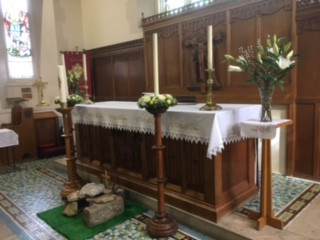
Lady Kathleen Edwards of Hendrefoilan House gave the Chancel in memory of
her husband Sir John Edwards, Baronet and she became Vicar’s Warden of the
Parish in 1929 -1946. The lectern was given by members of the Mothers’
Union. The pulpit was given by an anonymous donor, but it seems that this
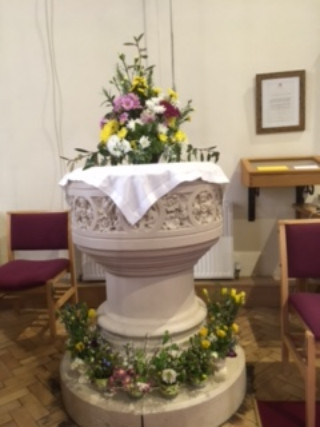
was Mrs. D. Williams of Upper Killay. The font came from the Parish of Penrice
and Admiral Sir Henneage Vivian presented a chalice and paten. Sir Clive
Edwards and his sister presented an altar cross and candlesticks. St. Hilary’s
was consecrated on August 10 th , 1926 leaving parishioners with a debt of
£3,200. Over the years, many donations were made to the new church.
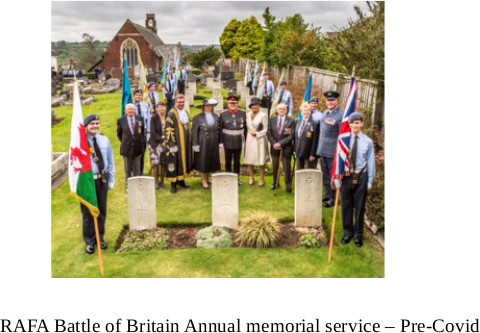
During the war years, a section of the churchyard was used for the graves of
aircrew based at Fairwood, who were lost in action. This is now maintained by
the Commonwealth War Graves Commission, and we remember those who
made the utmost sacrifice at the war graves on Remembrance Sunday. St.
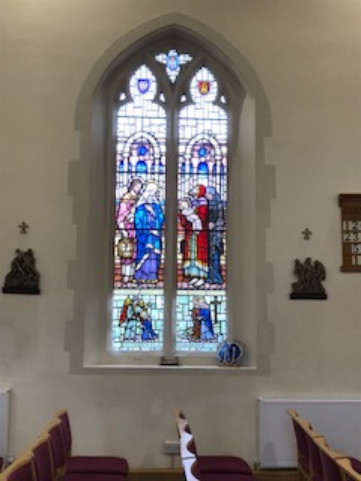
Hilary’s has beautiful stained-glass windows in different styles. One of the
earliest windows was dedicated to the fallen in 1947 with its theme from
‘Pilgrim’s Progress.’
The building has suffered from damp over the years, repairs have been done to
the bell, the roof and to the bath stone. The pipe organ was replaced by an
electronic organ in 1996. Various items have been given to the church by
parishioners in memory of family members and regular fund raising and grants
have been and are still being used to raise the money for new initiatives.
Now part of the Gower Ministry Area, St. Hilary’s will celebrate its centenary in
2026.

 Gower Ministry Area